Average Reviews:

(More customer reviews)Anderson Power Poles have become *the* standard DC connector used in Amateur Radio in the US, to the point where most emergency organizations specify them to facilitate interoperability. They are strong, reliable, genderless, easy to wire, and easy to reuse. The contacts' ability to handle amperage is limited primarily by the wire size they will accept, i.e., they will safely handle more amps (from surges or whatever) without self-destructing. The contact area is actually the same for the 15, 30, and 45 amp contacts. The contacts are self-wiping and rated to over 100,000 cycles.
The housings slide together in a variety of ways to form connector blocks as needed. The resulting blocks may be left as-is, pinned, cable-tied, glued, or fastened together using special Anderson clips. Most recommend strongly against using pins as they can fall out given enough vibration. Note also that some dealers substitute standard roll pins for the Anderson spiral pins. Anderson's bite into the plastic and hold better, but can still fall out. If you glue, use a drop of superglue between the housings (Anderson's recommendation) or model cement.
It is better to crimp than solder the contacts. While it is perfectly possible to solder the contacts, any solder on the contact face lowers the connect/disconnect cycle rating, as can overheating the contact. Solder can also interfere with the contact to housing fit. Finally, as these connectors are generally used with stranded wire, soldering forms a failure point where the flexible wire meets the stiff, soldered wire and connector. UL requires soldered Power Pole connectors to use a strain relief as a result.
You can use a plier-type crimp tool, like GB or Klein - both available at the big box home centers, but a die-type tool works far better. The GB will work on the 30 amp contacts, but crushes the 15s and won't work at all on the 45s. The Klein does better, but still won't do the 45s. The 45s must be crimped properly, even if subsequently soldered, as these are ear-type contacts, and the ears have to be crimped INTO the wire.
Anderson sells a crimp tool, but it's several hundred dollars. The best tool on the market for the money is the ratcheting West Mountain crimp tool specifically made for Power Pole contacts, and costs about $50. It produces an aerospace quality crimp and can be adjusted to produce crimps within a few thousands of a given specification. It can be purchased at any ham radio store or website. It handles the 15s, 30s, and 45s on a single die.
Click Here to see more reviews about: 45A Power Pole Connector (4 Black, 4 Red) Anderson-Sermos
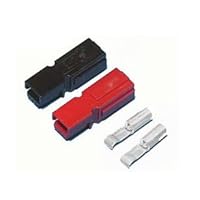
PowerPole connectors (formerly known as Sermos connectors) from Anderson Power Products have been very popular with electric airplanes and sailplanes. They were the first low-resistance connectors - made of silver-plated copper. The secret of their success is the stainless steel leaf spring built into the plastic housing. This spring applies 25 lb of pressure onto the contacts, ensuring good, vibration-proof contact. Contact resistance has been measured at 600 micro-ohms.PowerPoles are genderless, which means any connector can be plugged into any other connector. Electric fliers will have to exercise caution when using a speed controller (however, they are color coded). There is one distinct advantage to these connectors: if you have two packs you can use them separately and still plug them together in series. Also, these connectors link together side-by-side using keys that are molded into the side of the housings. When linked together, they become polarised!PowerPole connectors are very easy to use (we recommend soldering), compact, will handle moderate current, and are insulated but not polarised unless you slide them together in pairs. These are 45 Amp connectors, suitable for wiring up to 13ga. This item includes: 4 black plastic housing, 4 red plastic housings, and 8 pins.

Click here for more information about 45A Power Pole Connector (4 Black, 4 Red) Anderson-Sermos

0 comments:
Post a Comment