Average Reviews:

(More customer reviews)I wrote the RCGroups.com review on this. Go there and search it out for the nitty-gritty details.
Basically, this can handle any charging needs.
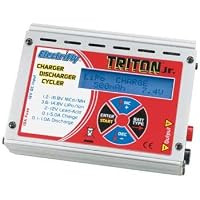
It charges lead acid, NiCd, NiMH, LiIo, and LiPo. The charge current is adjustable from 0.1 to 5.0 A. It is an automatic peak detecting charger. The buttons are the membrane-type, flush with the top and dust & water proof. (though the charger as a whole isn't)
One thing worth noting is that this charger has a DC input only. It needs to be supplied with 12 VDC. It isn't shown in the stock photo, but it comes with DC input leads with battery clamps. Kind of like the ones on jumper cables, but much smaller.
What this means to you is one of two things:
1) It is a field charger, or
2) You'll need to also buy a 12 VDC power supply to supply it.
If you'll be doing most of your charging at home, this is a lot of hassle and expense to go through, and you would probably be better off just seeking a charger that has AC/DC input. If you'll be doing some charging at home and some in the field, it is probably worthwhile.
I have mine set up with a 13.5 A, 12 VDC power supply at home on the bench and I use the battery clips with a 7 Ah sealed lead acid battery in the field. Note that this is only good for charing small batteries. For charging larger batteries (such as the 3+ Ah packs used in RC cars and trucks) you'll either need to use your car battery or buy a deep cycle marine battery. If you use your car battery, be sure not to drain it down too deeply. Car batteries are not deep cycle; they cannot be drained super low over and over again. They are made to be continually recharged by the car's alternator.
Another point is that if you are sure you don't need the ability to charge lithium or lead acid type batteries, this charger is probably overkill. Less expensive peak chargers can be found for a lot less money that will charge NiCd and NiMH battery packs. ($30-50) One thing worth noting on those is that they sometimes do not have adjustable charge current, so they won't be as versatile for charging your transmitter batteries or receiver batteries.
This charger can also discharge, but since it doesn't have a cooling fan, it can only do so at a 1 A level. It would take nearly 4 hours to discharge a 3600 mAh NiMH back at this rate.
The original Triton or Triton II will discharge at higher currents since they have cooling fans. Those chargers have a jog dial and discrete switches that will probably wear out much more quickly than the membrane switches on this model.
In short, this is a great charger for your field kit or as an all-around charger with a power supply for your home kit.
If you don't need to charge lead acid and LiPos, there are other less expensive options that are just as good.
Click Here to see more reviews about: Great Planes Triton Jr. Charger/Discharger/Cycler
Now you can get a charger with much of the versatility of the Triton for less! The Triton Jr. has many of the same basic features of the original, including the ability to charge, discharge, and cycle, and can be used with NiCd, NiMH, LiPo, Li-Ion, and Pb batteries. It s smaller in size and lighter in weight, so it s easier to transport, and perfect for smaller-sized electric flight applications.

Click here for more information about Great Planes Triton Jr. Charger/Discharger/Cycler

0 comments:
Post a Comment